Lists, patterns and polymorphism
ITT8060 Advanced Programming · Autumn 2026
Tallinn University of Technology
Full prose version with runnable examples: notes.html
 ITT8060
Overview
- Lists: values and constructors
- Recursion following the structure of lists
The purpose: an (as short as possible) introduction to lists, so that you can solve a problem which illustrates some of F#'s high-level features.
This part is not a comprehensive presentation on lists — next week is about lists and higher-order functions, and we return to the topic again later.
ITT8060Lists
ITT8060let ints = [ 2; 3; 6 ]
let strings = [ "a"; "ab"; "abc"; "" ]
let pairs = [ (1, true); (3, true) ]
let nested = [ []; [ 1 ]; [ 1; 2 ] ]
> [sin; cos];;
val it: (float -> float) list =
  [<fun:it@1>; <fun:it@1-1>]
Lists
A finite sequence of elements of the same type:
\([v_1;\ \ldots;\ v_n]\), and [] is the empty list.
Types:
int list,
string list,
(int * bool) list,
int list list — and
(float -> float) list.
;; ends an expression in F# Interactive only. Never needed in an
.fsx file.
ITT8060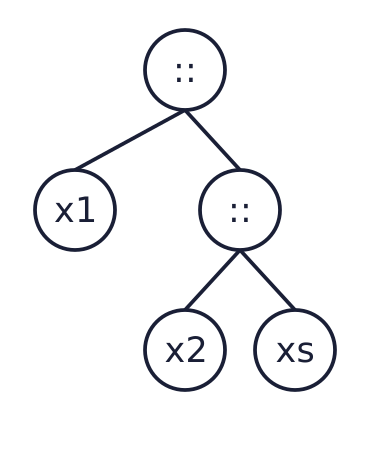
The constructors [] and ::
[]is a list — the empty list- if
xis an element andxsa list,x :: xsis a list
:: associates to the right:
\(x_1\ \mathtt{::}\ x_2\ \mathtt{::}\ xs\) means \(x_1\ \mathtt{::}\ (x_2\ \mathtt{::}\ xs)\)
ITT8060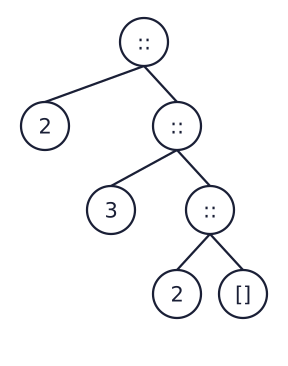
Head and tail
A non-empty list \([x_1;\ x_2;\ \ldots;\ x_n]\) with \(n \geq 1\) consists of
- a head \(x_1\) and
- a tail \([x_2;\ \ldots;\ x_n]\)
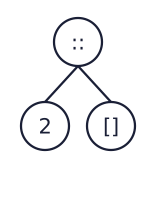
[2; 3; 2] is 2 :: 3 :: 2 :: [], and [2] is 2 :: [].
ITT8060
How a list is stored
The tree shows how [2; 3; 2] is built.
In memory each :: is a cons cell: the head, and a reference to the
tail. The empty list ends the chain.
Lecture 8 (tail recursion) builds on this picture.
ITT8060Recursion on lists
a simple example
ITT8060Summing a list
\[\mathtt{suml}\ [x_1;\ x_2;\ \ldots;\ x_n] \;=\; \sum_{i=1}^{n} x_i \;=\; x_1 + \sum_{i=2}^{n} x_i\]
The sum of a non-empty list is its head plus the sum of its
tail; the sum of [] is 0.
Constructors are used in list patterns.
ITT8060Recursion follows the structure of lists
let rec suml xs =
    match xs with
    | [] -> 0
    | x :: xs' -> x + suml xs'

// val suml: xs: int list -> int
suml [1; 2]
~> 1 + suml [2]        // x is 1, xs' is [2]
~> 1 + (2 + suml [])   // x is 2, xs' is []
~> 1 + (2 + 0)         // [] matches []
~> 1 + 2
~> 3
A list is either [] or x :: xs. One case for each; the recursive
call is on the tail.
ITT8060Outline for the rest of the lecture
- A further look at functions, including higher-order (curried) functions
- A further look at basic types, including characters, equality and ordering
- A first look at polymorphism
- A further look at tuples and patterns
- A further look at lists and list recursion
Goal: by the end of the day you are acquainted with a major part of the F# language.
ITT8060Functions
ITT8060From lecture 2
fun x -> e, match, and let f x = e ≡ let f = fun x -> e — with
their evaluation and typing rules — are in the
lecture 2 notes.
Currying: \(\mathtt{fun}\ x\ y\ \cdots\ z \to e\) means \(\mathtt{fun}\ x \to (\mathtt{fun}\ y \to (\cdots(\mathtt{fun}\ z \to e)\cdots))\)
Today: using them — pattern-matching functions, partial application, operators as functions, composition.
ITT8060Anonymous functions with patterns
let daysIn =
    fun x ->
        match x with
        | 2 -> 28              // February
        | 4 | 6 | 9 | 11 -> 30 // Apr Jun Sep Nov
        | _ -> 31              // all others
let daysInF =
    function
    | 2 -> 28              // February
    | 4 | 6 | 9 | 11 -> 30 // Apr Jun Sep Nov
    | _ -> 31              // all others
function is shorthand for fun x -> match x with.
daysIn 2 → 28, daysInF 4 → 30.
ITT8060let circleArea = fun r -> System.Math.PI * r * r
let circleAreaOf2 = circleArea 2.0
// val circleAreaOf2: float = 12.56637061
> fun r -> System.Math.PI * r * r;;
val it: r: float -> float

> it 2.0;;
val it: float = 12.56637061
Simple function expressions
A fun is a value — give it a name, or apply it directly.
In F# Interactive it names the last result.
ITT8060> fun x y -> x + x*y;;
val it: x: int -> y: int -> int
> let f = it 2;;
val f: (int -> int)
> f 3;;
val it: int = 8
Currying
The function takes an integer and returns a function of type
int -> int as its value.
Functions are first-class citizens: the argument and the value of a function may be functions.
ITT8060Function declarations
let circleArea r = System.Math.PI * r * r

// means

let circleArea = fun r -> System.Math.PI * r * r
let addMult x y = x + x * y
// val addMult: x: int -> y: int -> int

let addMult2 = addMult 2
// val addMult2: (int -> int)

addMult2 3          // 8
\(\mathtt{let}\ f\ x\ y\ \cdots\ z = e\) means \(\mathtt{let}\ f = \mathtt{fun}\ x \to (\mathtt{fun}\ y \to (\cdots(\mathtt{fun}\ z \to e)\cdots))\)
ITT8060let weight rho s = rho * s ** 3.0
// val weight: rho: float -> s: float -> float
let waterWeight = weight 1000.0
let methanolWeight = weight 786.5
// both: (float -> float)
waterWeight 2.0 // 8000.0
methanolWeight 2.0 // 6292.0
Partial application
A cube with side \(s\) containing a liquid of density \(\rho\) weighs \(\rho \cdot s^3\).
Partially apply weight to get the weight function for one
particular liquid.
Nothing is recomputed: waterWeight is weight with its first
argument fixed.
ITT8060Patterns
ITT8060Pattern matching in functions and in match
From lecture 2: the first matching pattern wins, and matching yields bindings (notes).
\[\mathtt{function}\ \ |\ pat_1 \to e_1\ \ \cdots\ \ |\ pat_n \to e_n\]
\[\mathtt{match}\ e\ \mathtt{with}\ \ |\ pat_1 \to e_1\ \ \cdots\ \ |\ pat_n \to e_n\]
The value of \(e\) is computed and the \(e_i\) of the first matching pattern is evaluated.
ITT8060let rec powerF = function
| (_, 0) -> 1.0
| (x, n) -> x * powerF (x, n - 1)
let rec powerM a = match a with
| (_, 0) -> 1.0
| (x, n) -> x * powerM (x, n - 1)
let rec power (x, n) = match n with
| 0 -> 1.0
| n' -> x * power (x, n' - 1)
// all three: float * int -> float
// powerF (2.0, 3) = 8.0, likewise powerM, power
Three declarations of power
With function; with match on the pair; with match on the exponent
only.
In fsi each could be called power — the new one shadows the old.
In a file, a second top-level power is a duplicate definition
error.
ITT8060Operators as functions
ITT8060> (+);;
val it: (int -> int -> int) = <fun:it@5-2>
let plusThree = (+) 3
// val plusThree: (int -> int)

plusThree 5          // 8
Infix operators are curried functions
The prefix version \((\oplus)\) of an infix operator \(\oplus\) is a function.
Arguments can be supplied one by one.
ITT8060let addThree y = y + 3 // f(y) = y + 3
let square x = x * x // g(x) = x * x
let h = addThree << square // h = f ∘ g
// val h: (int -> int)
h 4 // 19
((fun y -> y + 3) << (fun x -> x * x)) 4 // 19
Function composition
\((f \circ g)(x) = f(g(x))\): with \(f(y) = y + 3\) and \(g(x) = x^2\), \((f \circ g)(z) = z^2 + 3\).
<< is F#'s composition operator.
Type of <<?
ITT8060> (<<);;
val it: (('a -> 'b) -> ('c -> 'a) -> 'c -> 'b)
The type of <<
Given f : 'a -> 'b and g : 'c -> 'a, the composition f << g has
type 'c -> 'b.
'a, 'b, 'c are type variables — more in a moment.
ITT8060Basic types
equality and ordering
ITT8060compare 7.4 2.0 // 1
compare "abc" "def" // -3
compare 1 4 // -1
Equality and ordering
For the basic types — and many others — equality and ordering are defined.
\[\mathtt{compare}\ x\ y = \begin{cases} > 0 & x > y \\ 0 & x = y \\ < 0 & x < y \end{cases}\]
Only the sign is specified.
ITT8060let ordText x y =
match compare x y with
| t when t > 0 -> "greater"
| 0 -> "equal"
| _ -> "less"
ordText "abc" "Abc" // "greater"
Pattern matching with guards
The first clause is only taken when t > 0 evaluates to true.
when guards: a pattern plus a condition.
ITT8060val ordText: x: 'a -> y: 'a -> string
when 'a: comparison
ordText true false          // "greater"
ordText (1, true) (1, false) // "greater"
Polymorphism and comparison
The type contains a type variable 'a and a type constraint
'a : comparison.
'a can be instantiated to any type — provided comparison is
defined for it. A polymorphic type.
ITT8060> ordText sin cos;;
ordText sin cos;;
--------^^^
stdin(13,9): error FS0001: The type ''a -> 'a'
does not support the 'comparison' constraint.
For example, it does not support the
'System.IComparable' interface
Comparison is not defined for functions
The constraint makes the compiler reject the application — rather than let it fail at run time.
ITT8060Characters
and type annotations
ITT8060let isLowerCaseVowel ch =
System.Char.IsLower ch
&& (ch = 'a' || ch = 'e' || ch = 'i'
|| ch = 'o' || ch = 'u')
// val isLowerCaseVowel: ch: char -> bool
isLowerCaseVowel 'i' // true
isLowerCaseVowel 'I' // false
"abc"[0] // 'a'
Characters
Type char; values 'a', ' ', '\''.
The \(i\)-th character of a string: s[i].
Legacy syntax s.[i] (before F# 6) still compiles; write s[i].
ITT8060let square x = x * x // int -> int, default
let squareArg (x: float) = x * x // the argument
let squareRes x : float = x * x // the result
let squareExpr x = (x * x: float) // expression
let squareVar x = (x: float) * x // a variable
// all four: float -> float
Overloaded operators and type inference
* is overloaded; with nothing to decide, F# defaults to int.
One type annotation anywhere fixes the overload — and you can mix the four placements.
ITT8060Tuples
ITT8060(1, 2.0, true) = (2 - 1, 2.0 * 1.0, 1 < 2)
// true
compare (1, 2.0, true) (2 - 1, 3.0, false)
// -1
Tuples: equality and ordering
From lecture 2: an ordered collection of \(n\) values is an \(n\)-tuple (notes).
Equality componentwise, ordering lexicographically — provided they are defined on the components.
The comparison stops at the first component that differs.
ITT8060Tuple patterns
let ((x, _), (_, y, _)) =
    ((1, true), ("a", "b", false))

// val x: int = 1
// val y: string = "b"
> let (x,x) = (1,1);;

  let (x,x) = (1,1);;
  -------^
stdin(14,8): error FS0038:
  'x' is bound twice in this pattern
Pattern matching yields bindings; patterns nest, _ skips.
Restriction: a variable occurs at most once in a pattern.
ITT8060Local declarations
type abbreviations, exceptions
ITT8060let g x =
let a = 6
let f y = y + a
x + f x
// val g: x: int -> int
g 1 // 8
Local declarations
From lecture 2: a let inside a body is local to that body
(notes).
a and f are not visible outside of g.
ITT8060type Equation = float * float * float
type Solution = float * float
exception Solve
let solve (a, b, c) =
if b*b - 4.0*a*c < 0.0 || a = 0.0 then
raise Solve
else
((-b + sqrt (b*b - 4.0*a*c)) / (2.0*a),
(-b - sqrt (b*b - 4.0*a*c)) / (2.0*a))
solve (1.0, -3.0, 2.0) // (2.0, 1.0)
Types and exceptions
Solve \(a x^2 + b x + c = 0\).
solve : Equation -> Solution — a type abbreviation is a new
name, not a new type.
raise Solve when there is no real solution.
ITT8060Solution using local declarations
let solveD (a, b, c) =
    let d = b * b - 4.0 * a * c
    if d < 0.0 || a = 0.0 then
        raise Solve
    else
        ((-b + sqrt d) / (2.0 * a),
         (-b - sqrt d) / (2.0 * a))
let solveSqrt (a, b, c) =
    let sqrtD =
        let d = b * b - 4.0 * a * c
        if d < 0.0 || a = 0.0 then raise Solve
        else sqrt d
    ((-b + sqrtD) / (2.0 * a),
     (-b - sqrtD) / (2.0 * a))
d declared once, used three times: readability, efficiency.
Indentation matters.
ITT8060Example
rational numbers
ITT8060A signature
type qnum = int * int             rational numbers
exception QDiv                    division by zero
mkQ      : int * int  -> qnum     construction
.+.      : qnum * qnum -> qnum    addition
.-.      : qnum * qnum -> qnum    subtraction
.*.      : qnum * qnum -> qnum    multiplication
./.      : qnum * qnum -> qnum    division
.=.      : qnum * qnum -> bool    equality
toString : qnum -> string         string representation
Operations and their types, before any code.
ITT8060let q1 = mkQ (2, 3)
let q2 = mkQ (12, -27)
let q3 = mkQ (-1, 4) .*. q2 .-. q1
let q4 = q1 .-. q2 ./. q3
toString q4 // "-2/15"
// without infix notation:
let q3' = (.-.) ((.*.) (mkQ (-1, 4)) q2) q1
Intended use
- \(q_1 = \frac23\)
- \(q_2 = -\frac{12}{27} = -\frac49\)
- \(q_3 = -\frac14 \cdot q_2 - q_1 = -\frac59\)
- \(q_4 = q_1 - q_2 / q_3 = -\frac{2}{15}\)
Operators are infix with the usual precedences.
ITT8060type qnum = int * int
let rec gcd = function
| (0, n) -> n
| (m, n) -> gcd (n % m, m)
// gcd (12, 27) = 3
let canc (p, q) =
let sign = if p * q < 0 then -1 else 1
let ap = abs p
let aq = abs q
let d = gcd (ap, aq)
(sign * (ap / d), aq / d)
// canc (12, -27) = (-4, 9)
Representation
\((a, b)\) with \(b > 0\) and \(\gcd(a, b) = 1\) — the representation invariant. \(-\frac{12}{27}\) is represented by \((-4, 9)\).
gcd: Euclid's algorithm. canc: cancel common divisors, fix the
sign.
ITT8060Program for rational numbers
a/b + c/d = (ad + bc) / bd
a/b - c/d = (ad - bc) / bd
a/b * c/d = ac / bd
a/b / c/d = a/b * d/c        (c <> 0)
a/b = c/d  iff  ad = bc
exception QDiv
let mkQ = function
    | (_, 0) -> raise QDiv
    | pr -> canc pr

let (.+.) (a, b) (c, d) = canc (a*d + b*c, b*d)
let (.-.) (a, b) (c, d) = canc (a*d - b*c, b*d)
let (.*.) (a, b) (c, d) = canc (a*c, b*d)
let (./.) (a, b) (c, d) = (a, b) .*. mkQ (d, c)
let (.=.) (a, b) (c, d) = (a, b) = (c, d)
let toString ((a, b): qnum) = $"{a}/{b}"
The program corresponds directly to the rules.
Functions must preserve the invariant of the representation — every
operator ends in canc.
ITT8060Pattern matching and recursion
unzip
ITT8060let rec unzip = function
| [] -> ([], [])
| (x, y) :: rest ->
let (xs, ys) = unzip rest
(x :: xs, y :: ys)
unzip [ (1, "a"); (2, "b") ]
// ([1; 2], ["a"; "b"])
unzip
\(\mathtt{unzip}\ [(x_0, y_0); \ldots; (x_{n-1}, y_{n-1})] = ([x_0; \ldots; x_{n-1}],\ [y_0; \ldots; y_{n-1}])\)
- pattern matching on the result of the recursive call
unzipis polymorphic. Type?List.unzipis in the library
ITT8060val unzip: ('a * 'b) list -> 'a list * 'b list
The type of unzip
Nothing in the declaration depends on the element types — so they are type variables.
Most of the functions you write this week exist in List. Writing them
yourself first is how you learn to read the library.
ITT8060Summary
You are acquainted with a major part of the F# language:
- lists,
[]and::, recursion following the structure of lists - higher-order (curried) functions and partial application
- operators as functions; function composition
<< - basic types, equality and ordering,
whenguards - polymorphism and the
comparisonconstraint - characters; type annotations for overloaded operators
- tuples and their ordering; tuple patterns
- local declarations, type abbreviations, exceptions
- a representation invariant, and functions that preserve it
ITT8060Next
Reading: Hansen & Rischel, chapter 3 and the beginning of chapter 4.
Homework 2 is issued this week: operations on lists and tuples, recursion.
Next week: discriminated unions, lists, higher-order functions on lists.
Full prose version with runnable examples: notes.html. The script is 03-lists-functions-tuples.fsx in course-materials.
ITT8060