Discriminated unions, lists and higher-order functions
ITT8060 Advanced Programming · Autumn 2026
Tallinn University of Technology
Full prose version with runnable examples: notes.html
 ITT8060
Overview
- Part I: Discriminated unions and records
- Part II: Lists
- Part III: Higher-order list functions
ITT8060Recall the match expression
match e with
| p_1 [ when c_1 ] -> e_1
| ...
| p_n [ when c_n ] -> e_n
Match e against the patterns from top to bottom. If p_i
matches, evaluate the guard c_i (missing guard = when true).
If c_i is true, then e_i is the result of the whole match.
Otherwise continue with the next pattern.
At most one e_i gets evaluated. The type of the match is the
type of the e_i.
ITT8060An example with "holes"
let rec foo (xs: int list) (n: int) : int =
  let y = ?1
  match xs with
  | []               -> ?2
  | x :: xs' when ?3 -> ?4
  | _                -> ?5
What are the "holes", and what can we fill them with? Two questions: the type the "hole" must have, and the names in scope there.
Hole  Type      In scope
?1    any type  xs, n, foo, ...
?2    int       xs, n, foo, y, ...
?3    bool      xs, n, foo, y, x, xs', ...
?4    int       xs, n, foo, y, x, xs', ...
?5    int       xs, n, foo, y, ...
Part I
Discriminated unions
ITT8060Motivation
We want a list of all addresses of a contact. An address can be:
type PhysAddr = string * string * string
type VirtAddr = string * string

let a1 : PhysAddr = "Ehitajate tee", "5", "Tallinn"
let a2 : VirtAddr = "juulius", "ttu.ee"
But a1 :: a2 :: [] does not type-check. (Why?)
Goal: a type in which we can combine the two address types. Informally:
type Address = PhysAddr + VirtAddr
The + is not valid F#. This is informal notation for the
disjoint union of the values of the two types: a value of type
Address is either a physical or a virtual address, not both.
ITT8060Defining and constructing
A discriminated union is a type with distinct cases — the discriminating part. The general scheme:
type type_name =
  | case_identifier_1 of type_1_1 [ * type_1_2 ...]
  ...
  | case_identifier_n of type_n_1 [ * type_n_2 ...]
A concrete example, combining string * string, int and int:
type StringsOrInts =
  | Strings of string * string
  | Left of int
  | Right of int
A case identifier constructs a value of the type.
Strings ("ab", "cd"), Left 17 and Right 17 all have type StringsOrInts.
Strings 17 does not type-check. Left 17 <> Right 17 is true.
ITT8060Deconstructing
A value soi : StringsOrInts had to be constructed by one of the
constructors. To use the value, we must say what to do in each case:
for Strings (s1, s2), for Left n and for Right n.
let foo (soi: StringsOrInts) : bool =
  match soi with
  | Strings (s1, s2) -> s1 = s2
  | Left n when n < 0 -> true
  | Left n -> n % 2 = 0
  | Right _ -> true
Case identifiers are patterns, and a case identifier only matches itself. The compiler tries to check that all possible cases are handled.
What is foo (Strings ("ab", "ab"))? What is foo (Left (-3))?
What is foo (Left 4)? What is foo (Right 17)?
ITT8060Enumerations as discriminated unions
type Colour = Red of unit
            | Green of unit
            | Blue of unit

let r : Colour = Red ()
Recall that () is the only value of type unit. A constructor without an
argument type is syntactic sugar for of unit.
type Colour = Red | Green | Blue
let b : Colour = Blue

let show (c: Colour) : string =
  match c with
  | Red -> "red"
  | Green -> "green"
  | Blue -> "blue"
A single constructor
type DifferentInt = DifferentInt of int

let di2int (di: DifferentInt) : int =
  match di with
  | DifferentInt n -> n

di2int (DifferentInt 17)       // 17
Values of DifferentInt are just ints with a label.
type Meter = M of float
type Kilogram = Kg of float
type Second = S of float
Useful because the three types are different. let kg : Kilogram = S
1.0 does not typecheck.
See also: units of measure.
ITT8060Recursive discriminated unions
A constructor's argument types may refer to the type being defined (no
rec needed).
type IntList = INil
             | ICons of int * IntList

let il1: IntList = INil
let il2: IntList = ICons (1, INil)
let il3: IntList = ICons (1, ICons (2, ICons (3, INil)))
Note the IntList argument to ICons, and no arguments to INil.
To use a value of a recursive DU we may need to use recursion.
let rec sumIntList (il: IntList) : int =
  match il with
  | INil -> 0
  | ICons (n, il') -> n + sumIntList il'

sumIntList il3   // 6
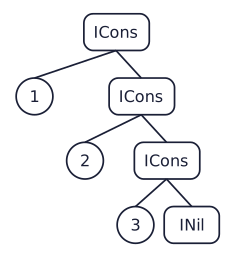
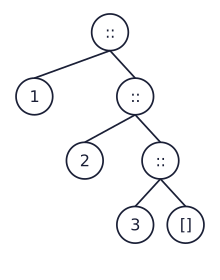
Standard lists
We draw the values
ICons (1, ICons (2, ICons (3, INil)))
and
1 :: 2 :: 3 :: []
as trees (of constructor applications).
They represent the same thing.
The built-in list type is a recursive discriminated union with
constructors [] and ::.
ITT8060Parameterised discriminated unions
type StringList = SNil
                | SCons of string * StringList
StringList differs from IntList only in the type of the first
Cons argument. We abstract it out as a type parameter.
type 'a PList = Nil                     // []
              | Cons of 'a * 'a PList   // ::

Cons (1, Nil)                           // int PList
This is how lists are defined in F#.
PList itself is not a type; int PList is. PList is a function on types.
The type parameter can also be given in angle brackets: PList<int>.
ITT8060The option type
Intuitively, take an existing type and add an additional value to it,
None. Used extensively in the standard library to represent the lack
of a value of type 'a.
// in the standard library:
// type 'a option = None | Some of 'a

let noInt: int option = None
let anInt: int option = Some 11
In Java, the class Integer has as values all int values plus
null. Every reference type has null as a value. With option we
can be more precise.
Different point of view: 'a option is the type of lists of length ≤ 1. (How?)
ITT8060let rec indexOf (el : 'a)
(xs : 'a list)
: int option =
match xs with
| [] -> None
| x :: xs' ->
if x = el then
Some 0
else
match indexOf el xs' with
| None -> None
| Some i -> Some (i + 1)
indexOf 3 [5; 3; 8] // Some 1
indexOf 7 [5; 3; 8] // None
Example: indexOf
Find the index of the first occurrence of el in xs.
Why return int option? What should the index of the first occurrence
be when el is not in xs?
When xs is empty, then we know the result. Otherwise, el is the
head, or, it is somewhere in the tail and we match on the result of
the recursive call.
Why return Some (i + 1)?
ITT8060A first look at records
the rest next week
ITT8060Records: aggregates of named values
type type_name = { label_1: type_1; ...; label_n: type_n }
Think of it as a tuple with named fields. Records are immutable:
with copies a record with some updated fields.
type Person = { name: string; age: int }
let tõnu = { name = "Tõnu"; age = 12 }
tõnu.age // 12
let tõnu2 = { Person.age = 12; name = "Tõnu" }
let mari = { tõnu with name = "Mari" }  // { name = "Mari"; age = 12 }
Every field must be supplied when constructing a value; order is free; a label may be qualified with the type name.
> let bad = { age = 12 };;
error FS0764: No assignment given for field
'name' of type 'Person'
let describe (p: Person) : string =
  match p with
  | { name = ""; age = _ } -> "empty string"
  | { name = n; age = a } ->
    $"Name is {n} and age is {a}"

type 'a NotList = { head: 'a; tail: 'a NotList }

let rec x = { head = 1
              tail = { head = 2; tail = x } }
x.head             // 1
x.tail.head        // 2
x.tail.tail.head   // 1
> let rec xs = 1 :: 2 :: xs;;
error FS0260: Recursive values cannot appear
directly as a construction of the type
'List`1' within a recursive binding. This
feature has been removed from the F# language.
More records
Record literals can be used as patterns.
Records can be recursive and parameterised.
Every NotList has a tail that is again a NotList (which has a head
element).
Not allowed for lists (but allowed with our PList).
ITT8060Part II
Lists
ITT8060Part II: Lists
- Generating lists using range expressions
- Example functions on lists:
append,reverse,isMember - Typical recursion patterns on lists
ITT8060Range expressions
A simple range expression \([b\ \mathtt{..}\ e]\), where \(e \geq b\), generates the list
\([b;\ b+1;\ \ldots;\ b+n]\)
where \(b + n \leq e < b + n + 1\). Empty when \(e < b\).
[ -3 .. 5 ]   // [-3; -2; -1; 0; 1; 2; 3; 4; 5]
[ 7 .. 4 ]    // []
With specified step:
\([b\ \mathtt{..}\ s\ \mathtt{..}\ e] = [b;\ b+s;\ \ldots;\ b+ns]\)
The list is ascending if \(s > 0\) and descending if \(s < 0\).
[ 6 .. -1 .. 2 ] // [6; 5; 4; 3; 2]
[ 2 ..  2 .. 6 ] // [2; 4; 6]
Range expressions with floats
[ 0.0 .. System.Math.PI / 2.0 .. 2.0 * System.Math.PI ]
// [0.0; 1.570796327; 3.141592654; 4.71238898; 6.283185307]
[ 2.4 .. 3.0 ** 1.7 ] // [2.4; 3.4; 4.4; 5.4; 6.4]
3.0 ** 1.7            // 6.47300784
Beware of precision loss when summing floats.
ITT8060Simple recursion on lists
Three simple functions — append, reverse, isMember — whose
declarations follow the structure of the list argument:
let rec f ... xs ... =
  match xs with
  | []       -> v
  | x :: xs' -> ... f xs' ...
What is the structure of 1 :: 2 :: 3 :: 4 :: 5 :: []?
let xs = 1 :: (2 :: (3 :: (4 :: (5 :: []))))

List.head xs = 1
List.tail xs = 2 :: (3 :: (4 :: (5 :: [])))
The tail of a nonempty list is a recursive substructure.
ITT8060Append
The infix operator @ joins two lists:
\([x_1;\ldots;x_m]\ \mathtt{@}\ [y_1;\ldots;y_n] = [x_1;\ldots;x_m;\ y_1;\ldots;y_n]\)
Properties:
- \([\,]\ \mathtt{@}\ ys = ys\)
- \([x_1;\ \ldots;\ x_m]\ \mathtt{@}\ ys = x_1\ \mathtt{::}\ ([x_2;\ \ldots;\ x_m]\ \mathtt{@}\ ys)\)
let rec append xs ys =
  match xs with
  | [] -> ys
  | x :: xs' -> x :: append xs' ys

append [1; 2] [3; 4]   // [1; 2; 3; 4]
(@) : 'a list -> 'a list -> 'a list is available in the standard library.
ITT8060append [1; 2] [3; 4]
~> 1 :: (append [2] [3; 4])
~> 1 :: (2 :: (append [] [3; 4]))
~> 1 :: (2 :: [3; 4])
~> 1 :: [2; 3; 4]
~> [1; 2; 3; 4]
Append: evaluation
ys is never taken apart.
Execution time is linear in the size of the first list.
Be careful with usage like: xs @ [x].
ITT8060Append: polymorphic type
The following are valid uses of append:
[1; 2] @ [3; 4]
// int list = [1; 2; 3; 4]

[[1]; [2; 3]] @ [[4]]
// int list list = [[1]; [2; 3]; [4]]
This is because @ is polymorphic in the type of elements of the list.
val (@): 'a list -> 'a list -> 'a list
The 'a is the type parameter.
For 'a = int, we have (@) : int list -> int list -> int list.
For 'a = int list, we have
(@) : int list list -> int list list -> int list list.
ITT8060Reverse
let rec naiveRev lst =
  match lst with
  | [] -> []
  | x :: xs -> naiveRev xs @ [x]

// val naiveRev: 'a list -> 'a list

naiveRev [1; 2; 3]   // [3; 2; 1]
naiveRev [1; 2; 3]
~> naiveRev [2; 3] @ [1]
~> (naiveRev [3] @ [2]) @ [1]
~> ((naiveRev [] @ [3]) @ [2]) @ [1]
~> (([] @ [3]) @ [2]) @ [1]
~> ([3] @ [2]) @ [1]
~> ...
~> [3; 2; 1]
\(\mathtt{naiveRev}\ [x_1;\ x_2;\ \ldots;\ x_n] = [x_n;\ \ldots;\ x_2;\ x_1]\).
naiveRev performs an @ for every element in the list. Recall that
@ is linear in the first argument.
Therefore, naiveRev is \(O(n^2)\) time.
Built-in List.rev is \(O(n)\). See fold in Part III for another linear
implementation.
ITT8060List membership
\(\mathtt{isMember}\ x\ [y_1;\ \ldots;\ y_n] = (x = y_1) \lor \mathtt{isMember}\ x\ [y_2;\ \ldots;\ y_n]\)
let rec isMember x lst =
  match lst with
  | [] -> false
  | y :: ys -> x = y || isMember x ys

isMember (1, true) [(2, true); (1, false)]  // false
isMember [1; 2; 3] [[1]; []; [1; 2; 3]]     // true
'a must satisfy equality: values of such types can be compared
with =. Tuples and lists of comparable things are fine as equality
is derived componentwise. Function types are not.
val isMember: x: 'a -> lst: 'a list -> bool when 'a: equality

> isMember sin [cos];;
error FS0001: ...
Match on results of the recursive call
let rec f ... xs ... =
  ...
  let pat(y) = f xs
  e(y)
Recall unzip from last week
(lecture 3 notes):
let (xs, ys) = unzip rest.
Two more examples: sumProd and split.
ITT8060Example: sumProd
\(\mathtt{sumProd}\ [x_0;\ \ldots;\ x_{n-1}] = (x_0 + \cdots + x_{n-1},\ x_0 \cdots x_{n-1})\)
Recursion formula: \(\mathtt{sumProd}\ [x_0;\ \ldots;\ x_{n-1}] = (x_0 + \mathit{rSum},\ x_0 \cdot \mathit{rProd})\) where \((\mathit{rSum}, \mathit{rProd}) = \mathtt{sumProd}\ [x_1;\ \ldots;\ x_{n-1}]\).
Base case \((0, 1)\): the neutral elements.
let rec sumProd lst =
  match lst with
  | [] -> (0, 1)
  | x :: rest -> let (rSum, rProd) = sumProd rest
                 (x + rSum, x * rProd)
// val sumProd: int list -> int * int

sumProd [2; 5]   // (7, 10)
Example: split
\(\mathtt{split}\ [x_0;\ x_1;\ x_2;\ x_3;\ \ldots] = ([x_0;\ x_2;\ \ldots],\ [x_1;\ x_3;\ \ldots])\)
let rec split lst =
  match lst with
  | [] -> ([], [])
  | [x] -> ([ x ], [])
  | x :: y :: xs -> let (xs1, xs2) = split xs
                    (x :: xs1, y :: xs2)

split [1 .. 7]   // ([1; 3; 5; 7], [2; 4; 6])
Notice a convenient division into three cases, and the recursion formula \(\mathtt{split}\ [x_0;\ x_1;\ x_2;\ \ldots] = (x_0\ \mathtt{::}\ \mathit{xs1},\ x_1\ \mathtt{::}\ \mathit{xs2})\)
where \((\mathit{xs1}, \mathit{xs2}) = \mathtt{split}\ [x_2;\ \ldots]\).
ITT8060Part III
Higher-order list functions
ITT8060Higher-order functions
Functions that accept a function as an argument or return a function as a result.
They are everywhere: \(\sum_{i=a}^{b} f(i),\quad \frac{df}{dx},\quad \{x \in A \mid P(x)\},\ \ldots\)
They are expressive and useful.
ITT8060Now down to earth
Many recursive declarations follow the same schema:
let rec f xs =
  match xs with
  | []       -> ...
  | x :: xs' -> ... (f xs') ...
- Goal: avoid repeating (almost) identical code fragments
- Solution: capture frequently occurring patterns as higher-order functions
- Result: more succinct and reusable declarations
Today: map, filter, fold, foldBack, exists, forall,
tryFind.
All of these are available in the List module; we try to define each one of them.
ITT8060Two simple list functions
let rec add n xs =
  match xs with
  | []       -> []
  | x :: xs' -> n + x :: add n xs'

// add: int -> int list -> int list

add 5 [-2; -1; 0; 1; 2]
//    [ 3;  4; 5; 6; 7]
let rec flip xs =
  match xs with
  | []       -> []
  | x :: xs' -> -1 * x :: flip xs'

// flip: int list -> int list

flip [-2; -1; 0;  1;  2]
//   [ 2;  1; 0; -1; -2]
The only difference: what happens to the elements (n + x vs -1
* x). The lists are processed in exactly the same way.
How to represent what happens to an element in the list?
With a function of type int -> int: fun x -> n + x vs fun x -> -1 * x.
ITT8060The map pattern
Take the element function int -> int as a parameter.
let rec mapInts (f: int -> int) (xs: int list) : int list =
  match xs with
  | []       -> []
  | x :: xs' -> f x :: mapInts f xs'

let addM n xs = mapInts (fun x -> n  + x) xs
let flipM  xs = mapInts (fun x -> -1 * x) xs
Nothing in mapInts is specific to int. If we drop the annotations,
then the inferred type is the most general type for map.
let rec map f xs =
  match xs with
  | []       -> []
  | x :: xs' -> f x :: map f xs'

// val map: f: ('a -> 'b) -> xs: 'a list -> 'b list
More examples
map : ('a -> 'b) -> 'a list -> 'b list applies the same transformation to every element:
\(\mathtt{map}\ f\ [v_1;\ \ldots;\ v_n] = [f\ v_1;\ \ldots;\ f\ v_n]\)
The transformation may transform the type of the element which is why there are two type parameters.
let arePositive xs = map (fun x      -> x > 0) xs   // int         list -> bool list
let addFstSnd  xys = map (fun (x, y) -> x + y) xys  // (int * int) list -> int  list

arePositive [-1; 0; 1]               // [false; false; true]
addFstSnd [(-1, 2); (1, 3); (2, 4)]  // [1; 4; 6]
Another point of view: given f : 'a -> 'b construct 'a list -> 'b list:
map : ('a -> 'b) -> ('a list -> 'b list)
Exercise
Declare a function \(\mathtt{g}\ [x_1;\ \ldots;\ x_n] = [x_1^2 + 1;\ \ldots;\ x_n^2 + 1]\)
Remember \(\mathtt{map}\ f\ [v_1;\ \ldots;\ v_n] = [f\ v_1;\ \ldots;\ f\ v_n]\).
There is also a map for option types. What does it do?
Option.map : ('a -> 'b) -> 'a option -> 'b option
Something similar to map
List.map : ('a -> 'b) -> ('a list -> 'b list)
map constructs a function 'a list -> 'b list from 'a -> 'b.
List.collect : ('a -> 'b list) -> ('a list -> 'b list)
List.collect constructs a function of the same type from a function
that transforms an element into a list. What does it do?
List.collect (fun x -> [0; x]) [1 .. 5] // [0; 1; 0; 2; 0; 3; 0; 4; 0; 5]
Filtering
Set comprehension: \(\{x \in xs : p(x)\}\)
filter p xs is the sublist of those elements x in xs for which
p x = true. Library function: List.filter.
let rec filter p xs =
  match xs with
  | [] -> []
  | x :: xs' -> if p x
                then x :: filter p xs'
                else filter p xs'

// val filter: ('a -> bool) -> 'a list -> 'a list

filter System.Char.IsLetter [ '2'; 'p'; 'F'; '-' ]  // ['p'; 'F']
System.Char.IsLetter c is true iff c is a letter.
ITT8060Combining a list into one value
let rec sum (xs: int list) : int =
  match xs with
  | []       -> 0
  | x :: xs' -> x + sum xs'

sum [1; 2; 3]   // 6
let rec prodabs (xs: int list) : int =
  match xs with
  | []       -> 1
  | x :: xs' -> abs x * prodabs xs'

prodabs [-2; 3; -4]   // 24
The two functions are very similar.
Differences: base value (0 vs 1), and how to combine the
element x with the recursive result (let's call it r).
What do the following functions represent?
fun x r -> x + rfun x r -> abs x * r
ITT8060A first generalisation
Abstract out the concrete details: the base value b, and the
function f combining an element x with a partial result r become
parameters.
let rec combineInts (f: int -> int -> int) (xs: int list) (b: int) : int =
  match xs with
  | []       -> b
  | x :: xs' -> f x (combineInts f xs' b)

let sumC     xs = combineInts (fun x r -> x     + r) xs 0
let prodabsC xs = combineInts (fun x r -> abs x * r) xs 1

sumC     [ 1; 2;  3]   // 6
prodabsC [-2; 3; -4]   // 24
Here we have sum and prodabs defined without (explicit) rec.
Again, nothing in the body of combineInts is specific to integers.
No reason to restrict this list recursion pattern to int list via
type annotations.
ITT8060Folding a list from the right ("backwards")
let rec foldBack (f: 'a -> 'b -> 'b) (xs: 'a list) (b: 'b) : 'b =
  match xs with
  | []       -> b
  | x :: xs' -> f x (foldBack f xs' b)

let sumB     xs = foldBack (fun x r -> x     + r) xs 0
let prodabsB xs = foldBack (fun x r -> abs x * r) xs 1
sumB [1; 2; 3]
= foldBack (+) [1; 2; 3] 0
~> 1 + (foldBack (+) [2; 3] 0)
~> 1 + (2 + (foldBack (+) [3] 0))
~> 1 + (2 + (3 + (foldBack (+) [] 0)))
~> 1 + (2 + (3 + 0))
~> 6
We fold back (from the right): the base value "goes" to the right of the list and we move from right to left.
ITT8060foldBack
For an infix \(\otimes\): \(\mathtt{foldBack}\ (\otimes)\ [a_0;\ \ldots;\ a_{n-1}]\ e = a_0 \otimes (a_1 \otimes (\cdots (a_{n-1} \otimes e)))\)
Many functions can be defined via foldBack (including append and map from
today).
let conj xs = foldBack (&&) xs true
conj [true; false; true]  // false

let appendB xs ys = foldBack (fun x r -> x :: r) xs ys
appendB [1; 2] [3; 4]  // [1; 2; 3; 4]

let lengthB xs = foldBack (fun _ r -> 1 + r) xs 0
lengthB ['a'; 'b'; 'c']  // 3

let mapB f xs = foldBack (fun x r -> f x :: r) xs []
mapB abs [-1; 2; -3]  // [1; 2; 3]
A map via foldBack, evaluated
let fn = fun x r -> abs x :: r
mapB abs [-1; 2; -3]
=  foldBack fn [-1; 2; -3] []
~> abs -1 :: foldBack fn [2; -3] []
~> abs -1 :: abs 2 :: foldBack fn [-3] []
~> abs -1 :: abs 2 :: abs -3 :: foldBack fn [] []
~> abs -1 :: abs 2 :: abs -3 :: []
~> 1      :: 2     :: 3      :: []
Each element is combined with the recursive result (folded tail) using
the function fn. As fn applies the function abs to the element
and cons-es it in front of the recursive result, we have map.
ITT8060Folding from the left
let rec fold (f: 'b -> 'a -> 'b) (r: 'b) (xs: 'a list) : 'b =
  match xs with
  | []       -> r
  | x :: xs' -> fold f (f r x) xs'

let rev xs = fold (fun rs x -> x :: rs) [] xs
rev [1; 2; 3]   // [3; 2; 1]
The accumulated result r is a parameter. We "update" the
accumulated result with every recursive call.
Using cons (::) with fold gives a linear time list reverse. How?
One cons per element, no append.
rev [1; 2; 3]
=  fold fn []                  [1; 2; 3]
~> fold fn (1 :: [])           [2; 3]
~> fold fn (2 :: 1 :: [])      [3]
~> fold fn (3 :: 2 :: 1 :: []) []
~> 3 :: 2 :: 1 :: []
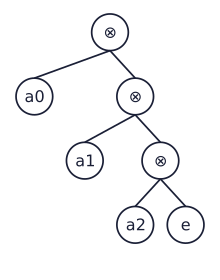
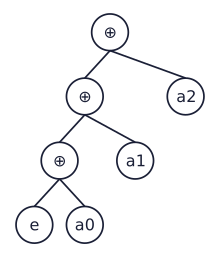
foldBack versus fold
\(\mathtt{foldBack}\ (\otimes)\ [a_0;\ a_1;\ a_2]\ e\)
Note how the tree leans to the right. Why? What does this mean?
\(\mathtt{fold}\ (\oplus)\ e\ [a_0;\ a_1;\ a_2]\)
Note how the tree leans to the left. Why?
ITT8060Comparing the two
There are functions for which fold and foldBack give different
results. For example, (-).
fold     (-) 0 [ 1; 2; 3 ]    // -6
foldBack (-) [ 1; 2; 3 ] 0    // 2

// ((0 - 1) - 2) - 3 = -6
// 1 - (2 - (3 - 0)) =  2
With cons: one reverses, the other copies. Why?
fold     (fun r x -> x :: r) [] [1; 2; 3; 4; 5]  // [5; 4; 3; 2; 1]
foldBack (fun x r -> x :: r) [1; 2; 3; 4; 5] []  // [1; 2; 3; 4; 5]
What properties must be satisfied so that fold f b xs = foldBack f xs b?
ITT8060exists
Here is the function exists : ('a -> bool) -> 'a list -> bool that
checks (decides) whether there exists an element in the list that
satisfies the predicate.
In other words, exists p xs = true precisely when there is some x
in xs such that p x = true.
let rec exists p xs =
  match xs with
  | []       -> false
  | x :: xs' -> p x || exists p xs'

exists (fun x -> x >= 2) [1; 3; 1; 4]   // true
Note that || is lazy (short-circuiting). What does that mean for exists?
Exercise: define exists as a fold. Compare its behaviour to the
given (direct) definition.
ITT8060Exercise
Define the function isMember (that decides list membership) in terms
of exists.
let isMember x ys = exists ??? ???
val isMember: 'a -> 'a list -> bool when 'a: equality
Remember: exists p xs = true precisely when there is some x in
xs such that p x = true.
ITT8060forall
Here is the function forall : ('a -> bool) -> 'a list -> bool that
checks (decides) whether every element in the list satisfies the
predicate.
In other words, forall p xs = true precisely when for every x in
xs we have p x = true.
let rec forall p xs =
  match xs with
  | [] -> true
  | x :: xs' -> p x && forall p xs'
// val forall: ('a -> bool) -> 'a list -> bool

forall (fun x -> x >= 2) [ 1; 3; 1; 4 ]   // false
Note that (&&) is also lazy. What does that mean for the definition
of forall?
Why is it that the base case ([]) of exists is false and
forall is true?
Exercise: define forall as a fold. Compare it to the given
definition.
ITT8060Exercises
Define the function disjoint : 'a list -> 'a list -> bool so that
disjoint xs ys is true when there are no common elements in xs
and ys, and false otherwise.
Define the function subset : 'a list -> 'a list -> bool so that
subset xs ys is true when every element of xs is also an element
of ys, and false otherwise.
Define the function inter : 'a list -> 'a list -> 'a list so that
x is an element of inter xs ys precisely when x is an element of
both xs and ys.
Note that inter produces a list. How should the elements be ordered?
Are duplicates allowed?
When appropriate, try to use the functions defined earlier.
ITT8060tryFind
Given a predicate p, find an element x from a list xs such that
p x = true.
let rec tryFind p xs =
  match xs with
  | []                -> None
  | x :: xs' when p x -> Some x
  | _ :: xs'          -> tryFind p xs'
// val tryFind: ('a -> bool) -> 'a list -> 'a option

tryFind (fun x -> x > 3) [ 1; 5; -2; 8 ]   // Some 5
The result type is 'a option. Why?
When is the result None and when is it Some x?
ITT8060Exercise: union of sets
We represent a set as a list with unique elements (without duplicates).
Uniqueness is an invariant that the operations must preserve: if xs
and ys are sets (lists wihtout duplicates) and f is a
set-operation, then f xs ys must also be a set (list without
duplicates).
Define the set-operation insert : 'a -> 'a list -> 'a list that
corresponds to the following operation on sets: \(x \cup X\).
In other words, insert x xs should represent the set \(x \cup X\)
where \(X\) is represented by the list xs.
What should be the result when x is already in xs? Does the order
of elements matter?
Define the set-operation union : 'a list -> 'a list -> 'a list.
ITT8060Summary
Many recursive list functions follow the same pattern:
let rec f xs =
  match xs with
  | []       -> ...
  | x :: xs' -> ... (f xs') ...
Higher-order functions allow us to represent/capture such repeating patterns and thus avoid repetition.
Use well-known patterns to communicate your intent. (Similar: why do we prefer
for-loops to explicit use of goto?)
ITT8060Question
We know map : ('a -> 'b) -> 'a list -> 'b list.
With 'a = int and 'b = int its type is (int -> int) -> int list -> int list.
Not every function of type (int -> int) -> int list -> int list can
be defined as map f xs where f : int -> int and xs : int list.
Is this good or bad?
ITT8060Next
Reading (mandatory): Hansen & Rischel, chapter 3 (tagged values and records), chapter 4, and the beginning of chapter 5 (lists).
Homework 3 is issued this week.
ITT8060Appendix I
Some algebraic laws for higher-order functions
Where we assume that functions are pure.
ITT8060map
mapping the identity function is the same as doing nothing:
map id = id
mapping twice (composition of mappings) is the same as mapping once with the composition of the functions:
map f << map g = map (f << g)
Example:
let f x = x + 1
let g x = 2 * x

(map id) [1; 2; 3] = [1; 2; 3] = id [1; 2; 3]

(map f << map g) [1; 2; 3] = [3; 5; 7] = (map (f << g)) [1; 2; 3]
The second mapping does not compute the intermediate list map g [1;
2; 3].
ITT8060filter
Define conjunction of predicates 'a -> bool as:
let (.&&.) p q x = p x && q x // if p x then q x else false
filtering twice is the same as filtering once with the combined predicate:
filter p << filter q = filter (p .&&. q)
Example:
let p x = x > 0
let q x = x % 2 = 0

(filter p << filter q) [-2 .. 2] = [2] = (filter (p .&&. q)) [-2 .. 2]
The second filtering does not compute the intermediate list filter q [-2 .. 2].
ITT8060map and foldBack
Swap arguments:
let swap f x y = f y x
foldBack after map is a single foldBack:
swap (foldBack f) b << map g = swap (foldBack (f << g)) b
Example:
(swap (foldBack (+)) 0 << map ((*) 2)) [1; 2; 3]
  = 12
  = (swap (foldBack ((+) << ((*) 2))) 0) [1; 2; 3]
The second one does not compute the intermediate list map ((*) 2) [1;
2; 3]; it directly folds the list [1; 2; 3].
ITT8060filter and foldBack
Define guarded combine function (combine x and r using f only when p holds):
let guard p f x r = if p x then f x r else r
foldBack after filter is a guarded foldBack:
swap (foldBack f) b << filter p = swap (foldBack (guard p f)) b
Example:
(swap (foldBack (+)) 0 << filter ((>=) 3)) [1 .. 5]
  = 6
  = (swap (foldBack (guard ((>=) 3) (+))) 0) [1 .. 5]
The second one does not compute the intermediate list filter ((>=) 3)
[1 .. 5]; it directly folds the list [1 .. 5].
ITT8060Appendix II
shapes as a disjoint union
ITT8060type Shape =
| Circle of float
| Square of float
| Triangle of float * float * float
Circle 2.0 // Shape
Triangle (1.0, 2.0, 3.0) // Shape
Square 4.0 // Shape
Disjoint sets — an example
A shape is either a circle, a square or a triangle — the union of three disjoint sets.
The tags Circle, Square and Triangle are constructors.
ITT8060let area s =
match s with
| Circle r -> System.Math.PI * r * r
| Square a -> a * a
| Triangle (a, b, c) ->
let s = (a + b + c) / 2.0
sqrt (s * (s - a) * (s - b) * (s - c))
// val area: s: Shape -> float
area (Circle 1.2) // 4.523893421
Constructors in patterns
A shape-area function, declared following the structure of shapes.
A constructor only matches itself; matching binds the carried values:
area (Circle 1.2)
~> System.Math.PI * r * r   // r ↦ 1.2
~> ...