Recursive data types
ITT8060 Advanced Programming · Autumn 2026
Tallinn University of Technology
Full prose version with runnable examples: notes.html
 ITT8060
1 · From lists to trees
ITT8060Lists
In Lecture 4, ICons expects one recursive argument (of type IntList):
type IntList = INil
             | ICons of int * IntList
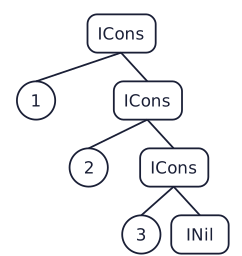
Today we ask what happens when a constructor expects a number of such recursive arguments?
ITT8060Binary trees
type 'a BinTree = Empty
                | Node of 'a BinTree * 'a * 'a BinTree
There are two constructors for constructing values of type 'a
BinTree: one for an empty tree and one for a node. Constructors can
be used as patterns to deconstruct values when matching.
The F# documentation calls them union cases; Empty and Node are
their case identifiers, the names written in the declaration.
We can read the declaration as rules: Empty is a tree; if l and
r are trees and x is a value, then Node (l, x, r) is a tree.
ITT8060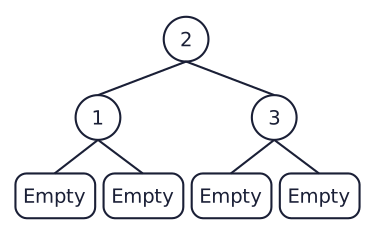
Drawing a tree
let small =
  Node (Node (Empty, 1, Empty), 2,
        Node (Empty, 3, Empty))
Here we have drawn every Empty.
From now on, we will omit them and the figures show the nodes only.
ITT8060let leaf x = Node (Empty, x, Empty)
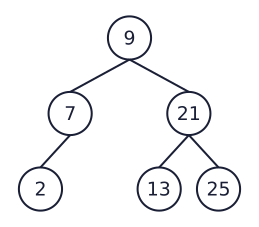
let t = Node (Node (leaf 2, 7, Empty),
9,
Node (leaf 13, 21, leaf 25))
Some terminology
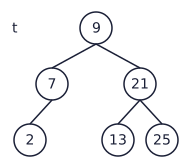
The root of t is 9. Its left and right subtrees are
rooted at 7 and 21, its children.
A leaf is a node whose both subtrees are empty: 2, 13 and 25.
size: the number of nodes. height: the number of nodes on a longest path from the root.
The empty tree has size 0 and height 0.
ITT8060let rec size t =
match t with
| Empty -> 0
| Node (l, _, r) -> size l + 1 + size r
let rec height t =
match t with
| Empty -> 0
| Node (l, _, r) ->
1 + max (height l) (height r)
Structural recursion
Recursive calls on recursive substructures (subtrees).
What are size t and height t?
6 and 3.
ITT8060Not every tree is finite
Interpreting the constructors of 'a BinTree as (inductive) rules, we
can only define finite trees. F# also accepts cyclic definitions:
let rec allOne = Node (allOne, 1, allOne)
allOne is an int BinTree: both subtrees are allOne itself, so the
tree is cyclic and infinite.
What is size allOne?
It never returns: the recursion never reaches Empty (stack overflow).
Recall that let rec xs = 1 :: 2 :: xs is rejected.
Functions defined by structural recursion terminate on finite trees.
ITT80602 · Binary search trees
ITT8060
The search-tree condition
For every Node (l, x, r) in the tree: every value in l is
less than x, and every value in r is greater than x.
Thus, a value occurs at most once.
The tree t is indeed a search tree.
ITT8060let rec insert x t =
match t with
| Empty -> Node (Empty, x, Empty)
| Node (l, y, r) ->
match compare x y with
| 0 -> t
| c when c < 0 -> Node (insert x l, y, r)
| _ -> Node (l, y, insert x r)
Insertion
Structural recursion; the constructors are used as patterns.
If x is already in t, then t itself is returned: no duplicates.
What type does F# infer for insert?
val insert:
  x: 'a -> t: 'a BinTree -> 'a BinTree
    when 'a: comparison
compare requires the comparison constraint.
ITT8060let rec contains x t =
match t with
| Empty -> false
| Node (l, y, r) ->
if x < y then contains x l
elif x > y then contains x r
else true
Membership
Only one path from the root is explored.
A comparison chain can also be written with if/elif.
What are contains 13 t and contains 8 t?
true and false.
ITT8060BST invariant not enforced by the type
let bad = Node (leaf 5, 3, Empty)
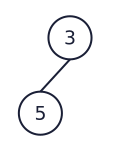
bad type-checks, but it is not a search tree.
Is contains 5 bad true?
false: at 3 the search goes right, but 5 is on the left.
ITT8060Preserving the invariant
A function f preserves an invariant if, for every x that satisfies
the invariant, the result f x also satisfies the invariant.
In other words, f preserves the search tree invariant when, for
every t that is a search tree, the result f t is also a search
tree.
This means that if t is not a search tree, then we do not require anything
from f t. ("garbage in, garbage out")
If f and g preserve the invariant and t is a search tree, then
any sequence of f and g applications (e.g., f (g (g (f t))))
results in a search tree.
Task: implement a Set (Lecture 5) library that internally uses an 'a
BinTree to represent the collection of elements as a search tree.
What should the library expose to its users and what should be kept hidden?
ITT8060let rec inOrder t =
match t with
| Empty -> []
| Node (l, x, r) ->
inOrder l @ [x] @ inOrder r
In-order traversal
The left subtree, then the node, then the right subtree.
What is inOrder t?
[2; 7; 9; 13; 21; 25]
For a search tree, the result is sorted.
ITT8060Removing the minimum
let rec removeMin t =
  match t with
  | Node (Empty, x, r) -> (x, r)
  | Node (l, x, r) ->
      let m, l' = removeMin l
      (m, Node (l', x, r))
let rec tryRemoveMin t =
  match t with
  | Empty -> None
  | Node (Empty, x, r) -> Some (x, r)
  | Node (l, x, r) ->
      tryRemoveMin l
      |> Option.map (fun (m, l') ->
           (m, Node (l', x, r)))
Left: F# warns that the match is incomplete, since Empty is not covered.
removeMin Empty fails at run time.
Right: total; the caller must handle None.
Which one would you use? Can we guarantee that t is not Empty?
ITT8060let rec remove x t =
match t with
| Empty -> Empty
| Node (l, y, r) ->
match compare x y with
| c when c < 0 -> Node (remove x l, y, r)
| c when c > 0 -> Node (l, y, remove x r)
| _ -> match tryRemoveMin r with
| None -> l
| Some (m, r') -> Node (l, m, r')
Removal
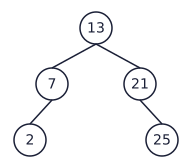
If the value is at a node, we put the smallest value of its right subtree in its place.
With tryRemoveMin, an empty right subtree is just the None case.
What is inOrder (remove 9 t)?
[2; 7; 13; 21; 25]
ITT8060let rec map f t =
match t with
| Empty -> Empty
| Node (l, x, r) ->
Node (map f l, f x, map f r)
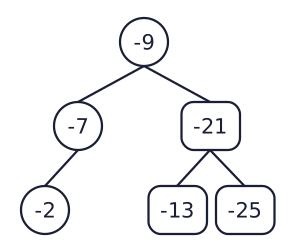
let neg = map (fun x -> -x) t
Mapping over a tree
map always preserves the shape of the tree but not necessarily the
search tree invariant.
Is contains (-21) neg true?
false: the search for -21 goes left at -9, but -21 is on the right.
ITT8060map sometimes preserves the invariant
A function f is monotone wrt a relation \(R\) if
\(x \mathrel{R} y\) implies \((f\,x) \mathrel{R} (f\,y)\).
If t is a search tree and f is monotone wrt <, then
map f t is a search tree.
Why do we require f to be monotone wrt <?
map f always preserves the shape of the tree.
map f where f is monotone (wrt <) also preserves the search-tree
invariant.
ITT8060A monotone function: doubling
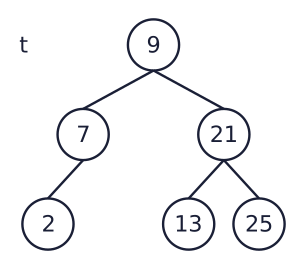
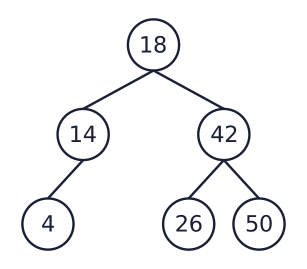
t (left) and map (fun x -> 2 * x) t (right). Is the result a search
tree?
Yes: fun x -> 2 * x is monotone with respect to <. Thus, if, for
some values x and y in t, we have x < y, then we have f x < f
y in the result.
In order: [4; 14; 18; 26; 42; 50].
ITT8060Why the relation is <
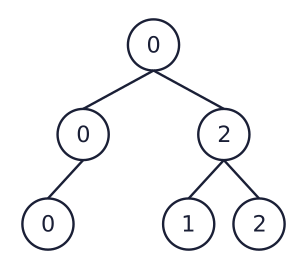
t (left) and map (fun x -> x / 10) t (right). fun x -> x / 10 is
monotone with respect to <=, but not <. Is the result a search tree?
No: the ordering is nondecreasing and allows duplicates.
In order: [0; 0; 0; 1; 2; 2].
The invariant is strict, so f must be monotone with respect to <.
ITT8060let rec foldBack f t e =
match t with
| Empty -> e
| Node (l, x, r) ->
foldBack f l (f x (foldBack f r e))
Folding a tree
Specification: foldBack f t e should compute the same result as:
List.foldBack f (inOrder t) e
without building the intermediate list inOrder t.
What is foldBack (-) t 0?
-13.
ITT8060as patterns
Inserting 3, 2 and 1 results in a chain; a rotation rebalances it:
let rotateRight t =
  match t with
  | Node (Node ((Node _ as ll), y, c), z, d) ->
      Node (ll, y, Node (c, z, d))
  | _ -> t
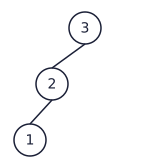
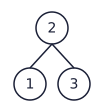
(Node _ as ll) checks that the grandchild is a Node and names it
ll: reused, not rebuilt.
Recommendation: put an as pattern in parentheses.
The goal: look deeper into a value, and keep the part you inspected as it is.
ITT80603 · Expression trees
ITT8060type Expr =
| Const of float
| X
| Add of Expr * Expr
| Sub of Expr * Expr
| Mul of Expr * Expr
| Div of Expr * Expr
let ex = Mul (X, Add (Const 2.0, X))
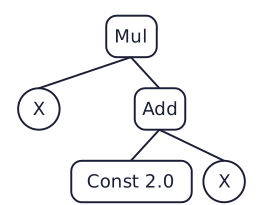
The type of expressions
Six constructors; as functions:
Const : float -> Expr
X : Expr
Add : Expr * Expr -> Expr
and Sub, Mul and Div like Add.
ex is a representation of \(x \cdot (2 + x)\).
Why does Expr have no constructor like Empty in 'a BinTree?
ITT8060let rec eval e x =
match e with
| Const c -> c
| X -> x
| Add (e1, e2) -> eval e1 x + eval e2 x
| Sub (e1, e2) -> eval e1 x - eval e2 x
| Mul (e1, e2) -> eval e1 x * eval e2 x
| Div (e1, e2) -> eval e1 x / eval e2 x
let ex = Mul (X, Add (Const 2.0, X))
Evaluation
Given a value for X, every expression denotes a number.
For e : Expr and x : float, evaluating e at x, eval e x, is
the value of e with x for X.
What is eval ex 4.0?
24.0
ITT8060let rec deriv e =
match e with
| Const _ -> Const 0.0
| X -> Const 1.0
| Add (e1, e2) -> Add (deriv e1, deriv e2)
| Sub (e1, e2) -> Sub (deriv e1, deriv e2)
| Mul (e1, e2) ->
Add (Mul (deriv e1, e2),
Mul (e1, deriv e2))
| Div (e1, e2) ->
Div (Sub (Mul (deriv e1, e2),
Mul (e1, deriv e2)),
Mul (e2, e2))
let ex = Mul (X, Add (Const 2.0, X))
Symbolic differentiation
With respect to X.
Structural recursion.
What is deriv ex?
Add (Mul (Const 1.0, Add (Const 2.0, X)),
     Mul (X, Add (Const 0.0, Const 1.0)))
The derivative as a tree
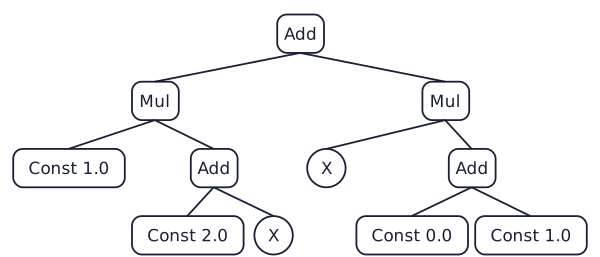
ex (left) and deriv ex (right).
The result could be simplified (for example, \(0 + y = y\), \(1 \cdot y = y\)).
eval (deriv ex) 4.0 is 10.0.
ITT80604 · Mutual recursion: file systems
ITT8060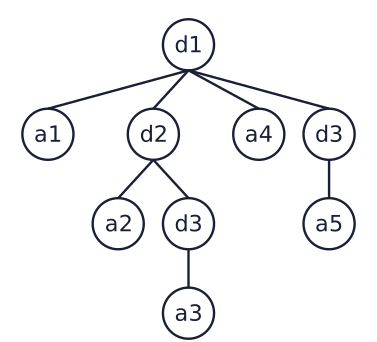
A file system
A file system is a list of entries.
An entry is a file, or a directory: a name and a file system.
ITT8060type FileSys = Entry list
and Entry =
| File of string
| Dir of string * FileSys
let d1 =
Dir ("d1",
[ File "a1"
Dir ("d2",
[ File "a2"
Dir ("d3", [ File "a3" ]) ])
File "a4"
Dir ("d3", [ File "a5" ]) ])
Mutually recursive types
Each declaration mentions the other, so they are declared together,
with and.
Without the name FileSys, Dir could take an Entry list.
What is the type of d1?
Entry
ITT8060let rec namesFileSys fs =
match fs with
| [] -> []
| e :: es -> namesEntry e @ namesFileSys es
and namesEntry e =
match e with
| File s -> [s]
| Dir (s, fs) -> s :: namesFileSys fs
Mutually recursive functions
Functions, too, are declared together with and.
What is namesEntry d1?
["d1"; "a1"; "d2"; "a2"; "d3";
 "a3"; "a4"; "d3"; "a5"]
What is the pattern used in namesFileSys?
ITT8060Summary
Recursive discriminated unions are trees.
The type definition determines the shape of the trees we can represent.
Today we saw binary trees, expression trees (four different binary nodes), and "file systems" where a node can have any number of children.
Types in F# are not expressive enough to enforce all invariants (search tree).
ITT8060Homework and reading
Homework 4 is out this week.
Reading: Hansen & Rischel, Functional Programming Using F#, chapter "Finite trees".
Exercises for the lab: the Exercises section of notes.html.
ITT8060