Code validation: from specifications to tests
Modules, NuGet, unit tests and the map of testing techniques
ITT8060 Advanced Programming · Autumn 2026
Tallinn University of Technology
How can code quality be assured based on specifications?
Full prose version with runnable examples: notes.html
 ITT8060
The question
How can code quality be assured based on specifications?
Since week 2 we have written specifications without calling them that:
the val lines F# Interactive prints, the "e.g. … should return" lines
of every homework, "a type is a promise" (Lecture 5),
factA n acc = acc * fact n (Lecture 8).
Lecture 8 derived code from a specification. Today the code is given, and we check it against the specification.
Plan: a specification says what · the module boundary · unit tests (NuGet, fixtures, runners) · properties and models · the map.
ITT80601 · A specification says what
A specification says what the code must do; validation compares the code with it.
ITT8060Three forms you have already used
A type: val insert: x: 'a -> t: 'a BinTree -> 'a BinTree when 'a: comparison
(Lecture 6). A promise for every input; the compiler checks it.
An example: "contains 13 t should return true" (every
homework's "e.g."). A test checks it.
An equation or an invariant: factA n acc = acc * fact n
(Lecture 8); "the in-order list of a search tree is sorted" (Lecture 6).
About all inputs at once.
Validation compares the code with the specification.
ITT8060Which form is it?
val insert: x: 'a -> t: 'a BinTree -> 'a BinTree when 'a: comparison- "
contains 13 tshould returntrue" factA n acc = acc * fact n- "the in-order list of a search tree is sorted"
- "
insertdoes the same asSet.addon the in-order list"
- A type — the compiler checks it, for every input, before the program runs.
- An example — a unit test (concept 3).
- An equation — a property test over many inputs (concept 4), or a derivation (Lecture 8).
- An invariant — a property test over many trees, or enforced at a module boundary (concept 2).
- A model — compare with the simpler implementation on the same inputs (concept 4).
ITT8060let rec fact n =
match n with
| 0 -> 1
| 7 -> fact 6
| n -> n * fact (n - 1)
let check name expected actual =
if expected = actual then true
else failwith $"check failed: {name}"
check "fact 0" 1 (fact 0)
check "fact 3" 6 (fact 3)
check "fact 5" 120 (fact 5)
A check on a point
All three checks pass. Is fact correct?
What is fact 7?
720. The specification "fact n = n * fact (n - 1) for every
n > 0" fails at 7.
A check on a point says nothing about the other points.
ITT80602 · The module boundary
A module boundary is where a specification is enforced: what a client cannot see, a client cannot break.
ITT8060From Lecture 6
'a BinTree with Empty and Node; insert, contains, inOrder.
The search-tree invariant: in every Node (l, x, r), all of l is
less than x and all of r is greater.
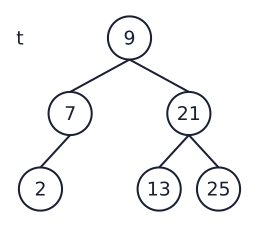
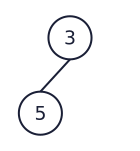
t (left) satisfies it. bad = Node (leaf 5, 3, Empty) (right) does
not, and the type does not care.
What is inOrder (insert 4 bad)?
[5; 3; 4] — not sorted. "Garbage in, garbage out."
ITT8060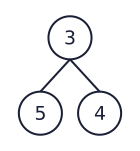
The tree insert 4 bad.
Garbage in, garbage out
insert preserves the invariant, but nothing stops a client from
writing Node (leaf 5, 3, Empty) and handing it to insert.
let isSearchTree t =
  let xs = inOrder t
  xs = List.sort xs && xs = List.distinct xs
isSearchTree t is true; isSearchTree bad is false.
What would keep the invariant? Make it impossible to build a tree
except through insert. That needs a boundary.
ITT8060module Greeting =
let private prefix = "Tere, "
let greet name = prefix + name + "!"
let greeting1 = Greeting.greet "Mari"
open Greeting
let greeting2 = greet "Jaan"
Modules
Every script and every file is a module (Lecture 2: "the toplevel of the module"). A module can also be declared inside a script.
Members are used with the module's name in front, or after open.
prefix is private: visible inside Greeting, invisible outside.
> Greeting.prefix;;
error FS1094: The value 'prefix' is not
accessible from this code location
[<RequireQualifiedAccess>]
module Temperature =
  let freezing = 0.0
  let toFahrenheit c = c * 9.0 / 5.0 + 32.0

let boiling = Temperature.toFahrenheit 100.0
Qualified access
Lecture 5 wrote Set.add, Map.find, List.map — never open Set.
The attribute keeps a module's short names out of your script.
> open Temperature;;
error FS0892: This declaration opens the
module 'FSI_0001.Temperature', which is
marked as 'RequireQualifiedAccess'. ...
Our search tree module is marked the same way.
ITT8060[<RequireQualifiedAccess>]
module SearchTree =
type 'a SearchTree when 'a : comparison =
private ST of 'a BinTree
let empty = ST Empty
let insert x (ST t) = ST (insert x t)
let contains x (ST t) = contains x t
let toList (ST t) = inOrder t
A search tree module
A search tree is a binary tree built by insert only.
The module wraps Lecture 6's tree in a one-case union whose case is
private — Lecture 7's trick for the email address. The insert on
the right is Lecture 6's.
let st =
  SearchTree.insert 4
    (SearchTree.insert 9
      (SearchTree.insert 7 SearchTree.empty))
SearchTree.toList st is [4; 7; 9].
ITT8060What can a client do?
Build bad through the module?
> let bad' = SearchTree.ST (Node (leaf 5, 3, Empty));;
error FS1093: The union cases or fields of the type 'SearchTree' are not
accessible from this code location
Only empty and insert build a search tree, and insert preserves
the invariant: every 'a SearchTree satisfies it. The invariant has
become a promise of the type.
What can a test of the module call?
Only what the module exports: empty, insert, contains, toList.
A test is written against the specification, not the representation,
and survives a change of representation.
ITT8060Files are modules
A file SearchTree.fs that starts with module SearchTree is the same
module as a file. A script loads it: #load "SearchTree.fs".
A file sees only the files loaded before it:
> #load "Client.fs" "SearchTree.fsi" "SearchTree.fs";;
Client.fs(3,13): error FS0039: The value, namespace, type or module
'SearchTree' is not defined.
No cycles; a project lists its files in the same order.
A namespace names a group of modules and types across files
(namespace Itt8060.Lecture9); a script cannot declare one.
ITT8060The signature file
SearchTree.fsi: the interface written down — the val lines, with the
representation left out.
module SearchTree

type 'a SearchTree when 'a : comparison

val empty : 'a SearchTree
val insert : 'a -> 'a SearchTree -> 'a SearchTree when 'a : comparison
val contains : 'a -> 'a SearchTree -> bool when 'a : comparison
val toList : 'a SearchTree -> 'a list
#load "SearchTree.fsi" "SearchTree.fs" loads the signature first; the
compiler checks the implementation against it.
ITT8060The compiler checks the signature
Declare val size : 'a SearchTree -> int in the signature without
implementing it:
SearchTree.fs(1,8): error FS0193:
  Module 'FSI_0001.SearchTree' requires a value 'size'
For a client, the constructor does not even exist:
> let bad' = SearchTree.ST
               (SearchTree.Node (SearchTree.Empty, 1, SearchTree.Empty));;
error FS0039: The value, constructor, namespace or type 'ST' is not defined.
A specification a client can bypass is a comment. Behind a module boundary it is a guarantee, and tests of the module test the guarantee.
ITT80603 · Unit tests
A unit test makes one example of the specification executable.
ITT8060check "contains 13 t" true (contains 13 t)
check "contains 8 t" false (contains 8 t)
check "inOrder" [2; 7; 9; 13; 21; 25] (inOrder t)
A plain check
We have one already: check from concept 1. These notes' exercises are
checked the same way when the notes are built: a hidden reference is
applied to the stated examples, and a mismatch stops the build.
Missing for a suite: a name for each test, a report that lists them, one command to run them all.
A library provides that. First, how to get a library.
ITT8060NuGet: where libraries come from
A library is a package on nuget.org: a name and a version. A script asks for it at its top:
#r "nuget: NUnit, 4.3.2"
The first time, F# Interactive fetches it over the network into the
local package cache (~/.nuget/packages):
> #r "nuget: NUnit, 4.3.2";;
[Loading C:\Users\juhan\.packagemanagement\nuget\Cache\0793...e460d.fsx]
module FSI_0002.0793...e460d
Every later run uses the cache: no network.
Then open NUnit.Framework, and the API from the package's
documentation: Assert.That (actual, Is.EqualTo expected), Is.True,
Is.Empty.
ITT8060NuGet: caveats
What does #r "nuget: NUnit" — no version — fetch?
> #r "nuget: NUnit";;
[Loading ...\nuget\Projects\38696--c955...382b\Project.fsproj.fsx]
> typeof<NUnit.Framework.TestAttribute>.Assembly.GetName().Version;;
val it: System.Version = 5.0.0.0 {...}
The newest release on the day (2026-10-28). Next month: perhaps another, with another behaviour. A script others will run pins its version.
This lecture pins 4.3.2, the version the .NET 10 SDK's test template uses.
A package brings its dependencies along (fsharp.core 10.1.302 arrived
with NUnit). A project lists the same packages as package references
in its project file — in a moment.
ITT8060A fixture
A test script loads NUnit and the module, then declares a fixture:
a type whose members are the tests — the shape of the course's own
tests. (ofList folds insert over a list.)
#r "nuget: NUnit, 4.3.2"
#load "SearchTree.fsi" "SearchTree.fs"

[<TestFixture>]
type SearchTreeTests () =
  [<Test>]
  member this.``toList empty is []`` () =
    Assert.That (SearchTree.toList (ofList ([]: int list)), Is.Empty)
  [<Test>]
  member this.``insert keeps the in-order list sorted`` () =
    let t = ofList [3; 1; 4; 1; 5]
    Assert.That (SearchTree.toList t, Is.EqualTo<int list> [1; 3; 4; 5])
Arrange, act, assert
Each test: arrange the input (let t = ofList ...), act
(SearchTree.toList t), assert one thing about the result. One
assertion per test, so that a failure names one broken promise.
The name is a sentence of the specification, in double backticks so that it may contain spaces. The report lists the names: the report reads as the specification.
[<Test>] marks a member as a test, [<TestFixture>] a type as a
group of tests. Is.EqualTo<int list>: NUnit has three EqualTo
overloads and F# cannot choose one for a list; the type argument says
which.
ITT8060Running a test is calling it
> #load "Tests.fsx";;
...
> open Tests;;
> SearchTreeTests().``toList empty is []`` ();;
val it: unit = ()
A loaded script is a module named after the file.
A test is a function: () when the assertion holds, an exception
when it does not. That is all there is to it.
ITT8060How a runner works
let runTests (asm: Assembly) =
  for fixture in asm.GetTypes () do
    if fixture.IsDefined typeof<TestFixtureAttribute> then
      let instance = System.Activator.CreateInstance fixture
      for test in fixture.GetMethods () do
        if test.IsDefined typeof<TestAttribute> then
          try
            test.Invoke (instance, [||]) |> ignore
            printfn "PASSED  %s" test.Name
          with e ->
            printfn "FAILED  %s\n%s" test.Name e.InnerException.Message
Discovery by attributes, every [<TestFixture>] type and every
[<Test>] method; invoke each test; an exception is a failure.
runTests typeof<SearchTreeTests>.Assembly at the end of the script.
ITT8060Running them all
> dotnet fsi Tests.fsx
PASSED  toList empty is []
PASSED  insert keeps the in-order list sorted
PASSED  contains finds an inserted value
What does the runner print for a fixture that tests fact at 0, 3, 5
and 7?
> dotnet fsi FactTests.fsx
PASSED  fact 0 is 1
PASSED  fact 3 is 6
PASSED  fact 5 is 120
FAILED  fact 7 is 5040
  Assert.That(, )
  Expected: 5040
  But was:  720
NUnit's message: the test, the expected value, the actual one.
ITT8060What the real runner adds
Ours lacks:
- Isolation — NUnit records failures in a context our runner never resets; call the failing test by hand after the run and the message lists the failure twice.
- Time limits — a test that loops forever hangs our runner.
- Parallel runs and a report in a standard format.
NUnit's own runner cannot run a script's fixtures (a script has no assembly file); the course's grader compiles its test scripts first. The usual way to the real runner is a project.
ITT8060The same tests in a project
> dotnet new nunit -lang F# -o SearchTree.Tests
The module, its signature and the fixture (under module Tests, no
runner) as compile items, in order; the packages as references:
<Compile Include="SearchTree.fsi" />
<Compile Include="SearchTree.fs" />
<Compile Include="Tests.fs" />

<PackageReference Include="Microsoft.NET.Test.Sdk" Version="17.14.0" />
<PackageReference Include="NUnit" Version="4.3.2" />
<PackageReference Include="NUnit3TestAdapter" Version="5.0.0" />
dotnet test restores them (the framework, the adapter that finds the
tests, the test host), builds and runs:
> dotnet test
Passed!  - Failed:     0, Passed:     3, Skipped:     0, Total:     3,
           Duration: 19 ms - SearchTree.Tests.dll (net10.0)
How your homework is graded
The course's automated tests work the same way, in scripts:
-
Your script is copied under a fixed name and loaded as a module, as
SearchTree.fswas. - One fixture per task holds the tests of that task's clauses, named as the clauses are: the names in your report are the members' names.
- A task's grade is the share of its tests that pass.
- Each test has a time limit: a function that loops forever fails instead of hanging the run.
- Some tests are property-based: a tool chooses their inputs. Next week.
ITT8060What a test cannot tell
fact passed its tests at 0, 3 and 5 and was wrong at 7.
A passing unit test says nothing about the inputs it did not use.
Tests check examples; the specification speaks about every input. Concept 4 closes the gap from the other side.
ITT80604 · Properties and models
Properties and models cover inputs you did not think of; a tool can choose the inputs.
ITT8060The "oracle" problem
Every check needs an expected result — an "oracle" that knows the answer.
An example: you compute it by hand (fact 5 is 120). Cheap;
limited to the inputs you thought of.
A property: a relation that holds without knowing the result
(fact n = n * fact (n - 1), rev (rev xs) = xs). Checkable on any
input — including inputs a tool chooses.
A model: a simpler implementation that computes the expected result
(Set.add for insert). Slow or naive is fine; it only has to be
right.
ITT8060Properties are equations
let forAll inputs p = List.forall p inputs

let revPairs =
  [ ([], []); ([1], [2])
    ([1; 2], [3]); ([1; 2; 3], [4; 5]) ]
Does rev (xs @ ys) = rev xs @ rev ys hold for these pairs?
forAll revPairs (fun (xs, ys) ->
    List.rev (xs @ ys) = List.rev xs @ List.rev ys)
false; the first failing pair is ([1], [2]). Reversing swaps the
halves: rev (xs @ ys) = rev ys @ rev xs holds on all four.
And fact n = n * fact (n - 1) over 1 .. 10? false, at 7. A
property is a specification; checking it over inputs is a test of the
specification itself.
ITT8060A model as the oracle
A search tree is a set, so Lecture 5's Set is the model: insert
should do to the in-order list what Set.add does to the set.
let modelInsert x xs = Set.toList (Set.add x (Set.ofList xs))
let build xs = List.fold (fun acc x -> insert x acc) Empty xs
let trees =
  [ build []; build [5]; build [3; 1; 4; 1; 5]
    build [9; 7; 2; 21; 13; 25]; build [1 .. 10] ]
Does inOrder (insert x t) = modelInsert x (inOrder t) hold for these
trees and x in 0, 4, 11?
forAll trees (fun t ->
    forAll [0; 4; 11] (fun x ->
      inOrder (insert x t) = modelInsert x (inOrder t)))
true. The model gives the expected result for every input: no
hand-computed answers.
ITT8060Next week, and the week after that
Both checks used inputs we wrote by hand. Two techniques let a tool choose them.
Property-based testing: a generator produces inputs of the required type, the property is checked on each, a failing input is "shrunk" to a smallest one that still fails. In F#: FsCheck. Next week.
Model-based testing: the specification is a model — a state machine or a reference implementation. A tool generates sequences of operations, runs them on the code and on the model, and compares. It finds wrong orders of operations, not just wrong values.
ITT80605 · The map
Each technique checks one form of specification over one part of the input space; quality is assured by choosing them together.
ITT8060The map of testing techniques
Technique |
Specification |
Who chooses the inputs |
Finds |
Cannot find |
|---|---|---|---|---|
Type checking |
types |
the compiler, for all inputs |
shape errors, before the run |
wrong values |
Unit tests |
examples |
you |
the cases you thought of |
everything else |
Property-based tests |
equations, invariants |
a generator |
the cases you did not think of |
what the generator never produces |
Model-based tests |
a model |
a tool, exploring sequences |
wrong sequences of operations |
what the model also gets wrong |
Runtime checks |
invariants, preconditions |
the real users |
violations in production, late |
anything before it runs |
Proof |
any statement |
nobody: all inputs at once |
every error, at the cost of a proof |
mistakes in the specification |
ITT8060Where does it go?
- A
valline that does not compile. check "fact 3" 6 (fact 3).forAll inputs (fun xs -> List.rev (List.rev xs) = xs).-
SearchTree.insertcompared withSet.addover sequences of inserts and removals. -
A "smart constructor" returning
Errorfor a malformed email address (Lecture 7).
- Type checking — a type; the compiler chose every input.
- A unit test — an example; you chose the input.
- A property-based test — an equation, over inputs a tool can choose.
- A model-based test — a model, over sequences of operations.
- A runtime check — an invariant, on the inputs the real users supply.
ITT8060The answer
How can code quality be assured based on specifications?
- Write the specification in a checkable form: a type, an example, an equation, an invariant, a model.
- Put it behind a module boundary, so that the implementation can change while the specification holds.
- Execute it, repeatedly, by machine — the runner in your script, the course's pipeline — so that every change is checked again.
- Choose the technique by the form of the specification and the size of the input space; no single technique covers the map.
ITT8060Summary
- A specification says what the code must do; validation compares the code with it.
- A module boundary is where a specification is enforced: what a client cannot see, a client cannot break.
- A unit test makes one example of the specification executable.
- Properties and models cover inputs you did not think of; a tool can choose the inputs.
- Each technique checks one form of specification over one part of the input space; quality is assured by choosing them together.
ITT8060Other tools you will meet
-
FsUnit: assertions that read as sentences on top of NUnit,
actual |> should equal expected. Its release must match the NUnit version (FsUnit 8 needs NUnit 5: not the 4.3.2 pinned here). -
Expecto: F#-native; tests are values,
testCase "name" <| fun () -> ..., in lists, run from a script or a console program. No attributes. -
xUnit: the other common .NET framework;
[<Fact>]for[<Test>],dotnet new xunit. - FsCheck: property-based testing. Next week.
The course's own tests use NUnit: that is what you need in order to read your results.
ITT8060Homework, reading and next week
Homework 6 continues; its defence is next week.
Reading: Hansen & Rischel, Functional Programming Using F#, chapter 7, "Modules" (a fast reading suffices); the F# language reference pages on modules, namespaces, signature files and package references in F# Interactive; the NUnit documentation.
Next week: property-based testing — a tool chooses the inputs.
The complete module, signature and test script, the project, and the exercises: the Worked examples and Exercises sections of notes.html.
ITT8060